
Islas Revillagigedo Expedición
January 6-13, 2013
The expedition to the Revillagigado Islands, Mexico was an extraordinary experience for many reasons. The main one being the amount of sea life and the health of the ecosystem but also for the group of people who came together to support the latest incarnation of The Watermen Project.
Both Yasmine, 13 years old, and a young German marine biology student Lukas, 22 years old had joined the expedition to expand their knowledge and experience of the ocean and of the scientific research being conducted by Dr. Mauricio Hoyos.
This was a real opportunity for these two young people to get up close and personal with the creatures that inhabit this ecosystem in ways that simply watching a video will never be able to equal.
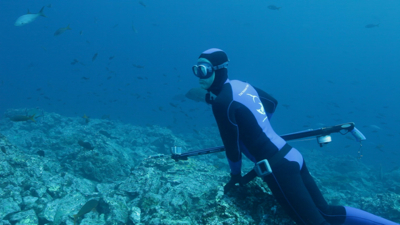
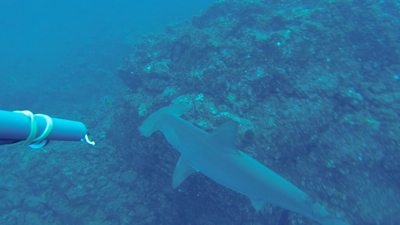
The work tagging on this trip was the toughest William has ever experienced. He had the misfortune to have heavy current on all but one session in the water and the scalloped hammerhead sharks (Sphyrna lewini) were deep… The first tag placed was at 22 meters and the rest were mostly between 34 and 40 meters. Even diving on an exhale still required finning down against the current in order to arrive at the most likely location to find the sharks. On average, William and his safety diver, Quebec freediving champion Philippe Beauchamp were doing 40 to 60 dives per day to place 2 tags. That is a lot of dives!
Yasmine had several encounters that re-enforced the value of this concept of The Watermen Project. At 13 years of age she saw a 4.5m tiger shark up close, Galapagos sharks, silver tip sharks, hammerhead sharks and she swam with a giant manta ray…as well as seeing scores of dolphins, hearing humpback whales singing and watching as they would swim by the boat etc…not bad for 13 years old!
Lukas not only shared in many of these encounters but also worked hard, logging data, keeping track of tags and getting in the water to watch the tagging. He left with a real idea of what this kind of work is like and what it entails for both the scientist and those of us that help in the research. He left the expedition even more inspired and passionate about the sea and sharks.
The other members of the expedition also who shared in the encounters with the different species of marine life as well as the evening talks given by Dr. Hoyos about sharks, his research and the particulars of the island we were visiting. Many thanks to them as their coming together to support sharks conservation is what made this expedition possible.
With about 300 dives over the course of 6 days, William managed to place sufficient tags that Dr. Hoyos will have the first chance in the past 5 years to have some good data about the scalloped hammerhead sharks and their behaviours. More than ever, sharks need to be protected as most species are threatened of extinction, in the name of a bowl of soup. In the eve of the next CITES meeting, this is more crucial than ever.
To read more on this issue, visit this page.
Update March 11, 2013: One step towards victory for sharks. Against all odds, 2013 CITES Summit in Bangkok votes for strictly controlled permits to export fins of oceanic whitetip, porbeagle and three species of hammerhead sharks. This is fantastic news. Read more about this here.