

Research on Breath-Hold
Freiburg im Breisgau | August 20, 2009
Undergoing scientific testing is a great way for breath-hold divers to better understand their body and to see if their (usually rigorous) training is adapted to their particular physiological disposition.
William was recently fortunate to meet with Dr. Stephan Walterspacher, MD, and his medical research team at the department of respiratory medicine of the university hospital of Freiburg im Breisgau, Germany.
Dr. Walterspacher and his team are very interested in safety aspects of breath-hold diving. One of their focus is on a technique frequently used by freedivers: buccal pumping (commonly known as packing in freediving lingo) as it relates to the lungs and central nervous interactions during breath-hold diving. Together with his team, Dr. Walterspacher is currently conducting two research projects:
Research project #1
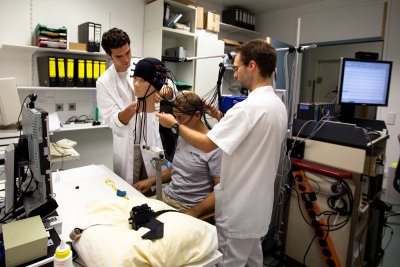
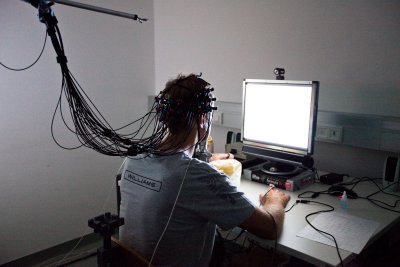
Setting: Neurology laboratory With a highly experimental setup, oxygen saturation is examined within the central nervous system during maximal dry breath-holds, using near infrared spectroscopy (a non-invasive technique (just like measuring oxygen saturation using a finger clip) using near-infrared light).
Why: Tests are carried out to see if the deoxygenation (occuring during long-term breath-holds) might lead to cerebral damage. In fact, a very recent publication in the Journal of Applied Physiology identified specific protein markers which would indicate brain damage taking place during long breath-holds. This might be due to insufficient blood-flow regulation during breath-holds.
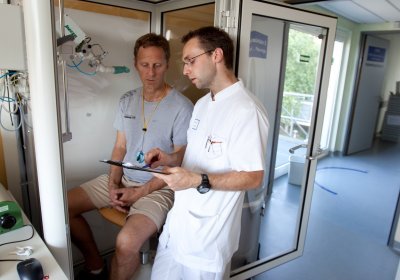
William states: “The infrared experiment was cool: if you look at the photos, you see them outfitting me with the system of sensors. There were about 35 light-emitting diodes on my head along with a set of headphones as I sat in front of a monitor, holding my breath and waiting for the loud music and obnoxious visuals to appear. It was not easy doing in excess of 4-minute breath-holds sitting bolt upright with my chin resting in position on a tripod but, I managed it.”
Results for this particular experiment will be produced in several months.
Research project #2
Setting: Respiratory laboratory
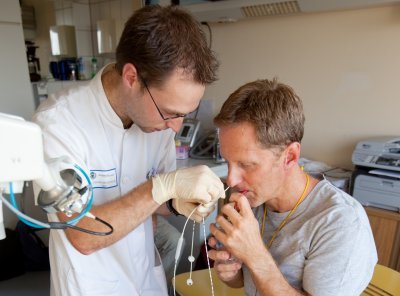
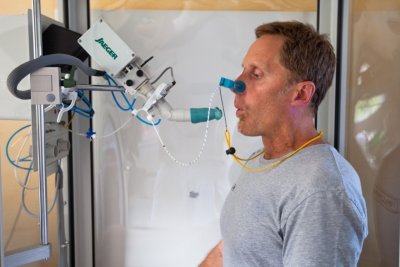
Routine measurements of lung volume and respiratory muscle strength are taken. Furthermore, the respiratory drive is studied using several concentrations of carbon dioxyde and lung compliance.
Why: The research team is, on one hand, looking for long-term damage signs in the lungs in divers whom they have studied for the last three years; on the other hand, they are looking at short-term damage signs of the lung by measuring lung compliance in their current subjects on a breath-hold after buccal pumping. They have found a promising marker in blood and urine that might show them how much damage to the lungs occur. Finally, they take a close look at how “sensitive” divers are reacting to increasing levels of carbon dioxide.
How: Urine and blood samples are taken to look for specific markers indicating lung damage (if any) when breath-hold divers pack extra air in their lungs using buccal pumping. Compliance of the lung is also measured using a pressure sensor placed in the oesophagus.
Finally, the response to increased levels of carbon dioxyde is measured while looking at the increment of respiratory drive measured using spirometry.
William recalls: “Imagine swallowing a catheter containing two evenly-spaced small balloons, all the way down to your stomach… Well, this one starts by passing through your nose out the back and then down the throat. Once in place, I had to take a few deep breaths hooked up to a computer so Dr Walterspacher could make sure the balloons were at the right level of the esophagus and then the experiment could begin. As I inhaled fully the balloons registered the elasticity of my lung tissue and then I packed as much air in as I could and once again the balloon system measured the elasticity during the overpacked breath-hold. I had to do several repeats of all of this and then the machine got a reading as to whether or not my lung elasticity was changing throughout this process. If swallowing the tube was not enough, I can tell you that doing breath-holds with little balloons in my oesophagus felt quite strange.”
“The final test was to see how I would respond to increasing levels of carbon dioxyde. For this experiment, I was hooked up to a closed circuit, within which the levels of carbon dioxide were gradually increased under the command of Dr Walterspacher. My responses to the varying levels of the gas were recorded. Contrary to the general population who increase their rate and frequency of breathing when exposed to higher levels of CO2, trained apneists like myself, tend to increase the volume of air exchanged in the lungs but not the frequency of the breath. This was interesting because earlier in the day, during the infrared spectroscopy, my carbon dioxide level was also being monitored and it was observed that without hyperventilating I was able to lower my carbon dioxyde level by 14%, just through deep, relaxed breathing like when I practice Tai Chi or Chi Gong.”
So far, Dr Walterspacher has drawn some conclusions from parts of the experiment. He explains: “William exceeded the average population by far. We can tell by the body plethysmosgraphy that he has a very trained lung, that means a large lung. He is able to breathe hard and fast and he can use a lot of his lung volume in a very short time. This is quite outstanding as can only be seen in very trained subjects. Interestingly, his response to CO2 does not seem to be as “delayed” as in other breath-hold divers; presumably he did not try to control it as much as the others. But, in contrast to the general population, breath-hold divers, including William, respond to CO2 mainly by increasing their tidal volume and not by increasing their breathing frequency. There is, and that’s a good thing, no change in lung elasticity, as measured by lung compliance, compared to normal subjects; indicating that there might not be overwhelming harm done to the lung by performing the packing manoeuver.”
For those of you reading and who are trained breath-hold divers, if you are interested in what is without a doubt very interesting research and would like to help out, please contact Dr. Stephan Walterspacher as he is looking for more volunteers. While the experiments described above are now actually almost finished, Dr Walterspacher already has plans for future studies in the beginning of 2010. He will be happy to meet with new elite divers (criteria: breath-hold duration of at least 5 minutes, diving for at least 2 years).
William Winram would like to thank Dr. Stephan Walterspacher and Sebastian Vogel of the University Hospital Freiburg, Department of Pneumology, Germany for carrying out this experiment despite the overwhelming summer heat.
Photos by Elizabeth Golay