
Mediterranean Sea | July 10 – August 3
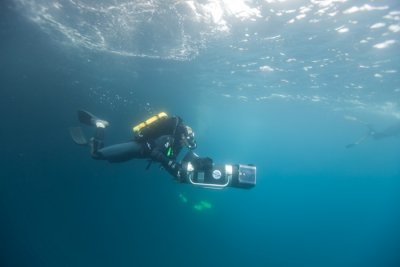
Once again, Fred Buyle and William Winram are joining their talent to capture “out of this world” images. At sea for a little over three weeks, they are free from the day-to-day city buzz, free from all Internet networks but most of all, they are free-diving some of the spectacular sites of the Mediterranean Sea.
Together with world-renowned cinematographers Christian Petron and Yves Lefèvre of Cinemarine Productions, they are filming for a series of high-definition documentaries for Project Ocean Quest.
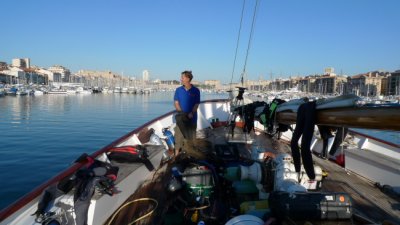
They are onboard the Garlaban sailing yacht (formely owned by Paul Ricard 1909 – 1997), which is nowadays assigned to missions to provide logistic support for scientific, cinematographic as well as educational expeditions.
Usually moored in Les Embiez harbour, it is in the old port of Marseille that the 27-meter sailing yacht welcomed Fred and William along with the crew, producers and videographers.
Filming a documentary is no walk in the park. Current, wind and visibility are the first limiting factors which dictate where and when footage will be filmed. Another factor which tends to arrive en masse is a large population of scuba divers. Considering that the focus of this particular film is to document the fragility of the Mediterranean Sea and the subtle relationship between freedivers and their underwater environment, millions of bubbles and the thrashing around of fins can be a frustrating sight.
Some of the amazing sites which Fred and William were lucky to anchor near and dive days on end were:
- Cap Sicié with its famous wreck dive site:
the Arroyo. A French auxiliary tanker built in 1921, the Arroyo was scuttled during the year 1953 near Cap Sicié (southernmost point of Les Deux Frères Islands) for the training of Navy divers. It’s a fairly accessible wreck, from 18 meters to 36 meters of depth.
- Porquerolles Island with one of the most popular wreck site of the Mediterranean Sea: the Donator (a.k.a. Prosper Schiaffino). This cargo ship built in 1931 was coming back from Algeria with her hold full of wine on November 10, 1945. Mines had not all been collected from the sea after the war had ended. On that day, the northern wind “Mistral” is forcing the Donator to navigate on the southern part of Porquerolles Island in high seas. When the cargo hits a floating mine, the bow is destroyed and the Donator sinks quickly. Fortunately, most of her crew will be rescued as a Royal Air Force plane is witness to this explosion. Considerably deeper (from 40 meters to 51 meters) than the Arroyo, diving the Donator is much more challenging. When current is present, it is usually strong, which prevents any kind of diving, as conditions are far too dangerous.
The Donator is now home to large schools of groupers (Epinephelus marginatus), dentex (Dentex dentex) and white seabream (Diplodus sargus) which frolic amongst the yellow (Eunicella cavolinii) and red Gorgonia (Paramuricea clavata).
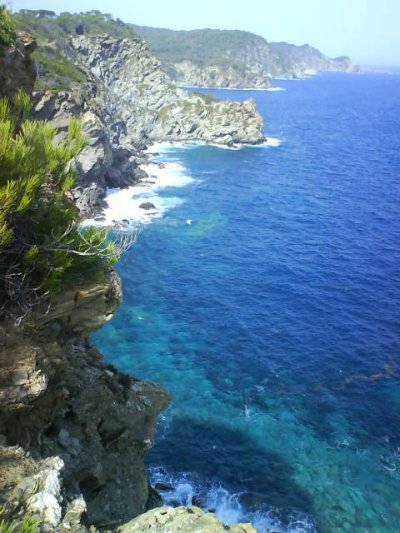
- The Gold Islands: Porquerolles, Port-Cros &Ile du Levant, located to the south of Hyères. Port-Cros was privately-owned by an ecologically-minded individual and has since been turned into a National Park to protect the breathtaking cliffs, crystalline coves and fine sandy beaches. The Port-Cros National Park also encompasses the Ilots de la Gabinière, de Bagaud and de Rascas.
Thankfully, not all footage is being taken underwater, some interviews were held in picturesque land locations such as the one to the right.
The documentary is to be released in 2010.